
Verifiable trust signals
for the agentic economy
AI agents use websites and APIs on behalf of people and businesses. A service may know which agent is calling, but not who is responsible for it or how it has behaved. That makes it difficult to decide what the agent should be allowed to do. Blocking every agent would also block intended business activity.
TSAI (Trust Signals for Agentic Interactions) is an open protocol developed through an industry initiative led by AWS and its partners. It defines a common way to carry verifiable trust signals between agents and services. Trust authorities check agents and the organisations responsible for them, then issue credentials. Agents present those credentials to service providers, which verify them and decide how to respond.
The scale of automated activity
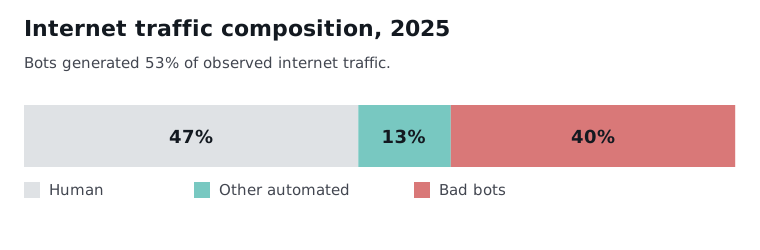
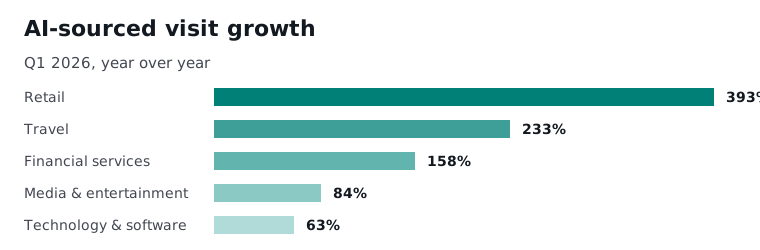
Automated systems already generate more than half of internet traffic, while AI-sourced visits are growing across industries. The two sources below measure different things, but both show the scale of the decision facing service providers. Treating all automation as one class cannot distinguish intended agent activity from abuse. TSAI adds verified evidence about the agent and operator to that decision.
What are trust signals?
A TSAI credential carries two layers of information: operator-level signals about the company behind the agent, and agent-level signals about the specific agent program. The trust authority signs the credential, and the service provider verifies it offline against published material — the common verification path does not contact the trust authority during the request.
Operator signals
The company behind the agent — verified once, shared across all its agents
- Legal identityAcme Corporation GmbH
- KYC levelEnhanced
- CertificationsISO 27001
- Controlled domainacme-corp.example
- Domain age2 years, 4 months
Agent signals
This specific agent program — builds its own track record over time
- Agent identityacme-corp.example/shopper
- Reputation score0.94
- Observation windowpast 90 days
- Interactions3,518
- Credential expiry30 minutes
Example payload
{
  "iss": "https://trust-authority.example",
  "vct": "https://tsaiprotocol.org/credential/tsai/1",
  "vct#integrity":
    "sha256-VWaSSviMOFcp1vsoU3ReObfIF8+sKBiEyfkL9npfZmA=",
  "iat": 1781863200,
  "exp": 1781865000,
  "sub": "https://acme-corp.example/agents/shopper",
  "cnf": { "jwk": { "kty": "EC", "crv": "P-256",
    "x": "TCAER19Zvu3OHF4j4W4vfSVoHIP1ILilDls7vCeGemc",
    "y": "ZxjiWWbZMQGHVWKVQ4hbSIirsVfuecCE6t4jT9F2HZQ" } },
  "signals": [
    { "cat": "idn", "typ": "org",
      "val": "Acme Corporation GmbH" },
    { "cat": "idn", "typ": "jur", "val": "DE" },
    { "cat": "idn", "typ": "kyc", "val": "enhanced" },
    { "cat": "idn", "typ": "dct",
      "val": "acme-corp.example", "asof": 1781860000 },
    { "cat": "idn", "typ": "dag",
      "val": "P850D", "asof": 1781860000 },
    { "cat": "cmp", "typ": "iso27001",
      "prv": "did:web:cert-corp.example",
      "asof": 1780000000 },
    { "cat": "rep", "typ": "ecommerce",
      "mtd": "https://trust-authority.example/rep/v1",
      "mtd#integrity":
        "sha256-Td9FdWbwljmeY78DD/gKxGxPSjjV9vzvOU3oXPH4dJY=",
      "scr": 0.94, "cnt": 3518, "wdw": "P90D",
      "asof": 1781800000 }
  ]
}vct and vct#integrity pin the credential definition, cnf carries the holder-binding key, and iat and exp mark the 30-minute lifetime. Each signal has a category (cat) and type (typ) with type-specific fields; reputation carries a normalised score (scr, 0–1), interaction count (cnt), observation window (wdw), and a pinned methodology (mtd, mtd#integrity). asof is when the trust authority last confirmed the fact.Implementation by role
Operators, service providers, and trust authorities have different implementation responsibilities. Each role has a dedicated path covering its integration and operations.
Operators
Register agents and binding keys, obtain short-lived credentials, create a fresh holder proof for each presentation, and manage key rotation or repudiation.
Implementation guidanceService providers
Publish accepted trust authorities, prepare verification material, verify presentations, and pass verified identity and signals to application policy.
Implementation guidanceTrust authorities
Enrol operators, register agents and keys, evaluate evidence, issue credentials, publish verification material and status, and operate signing infrastructure.
Implementation guidance